
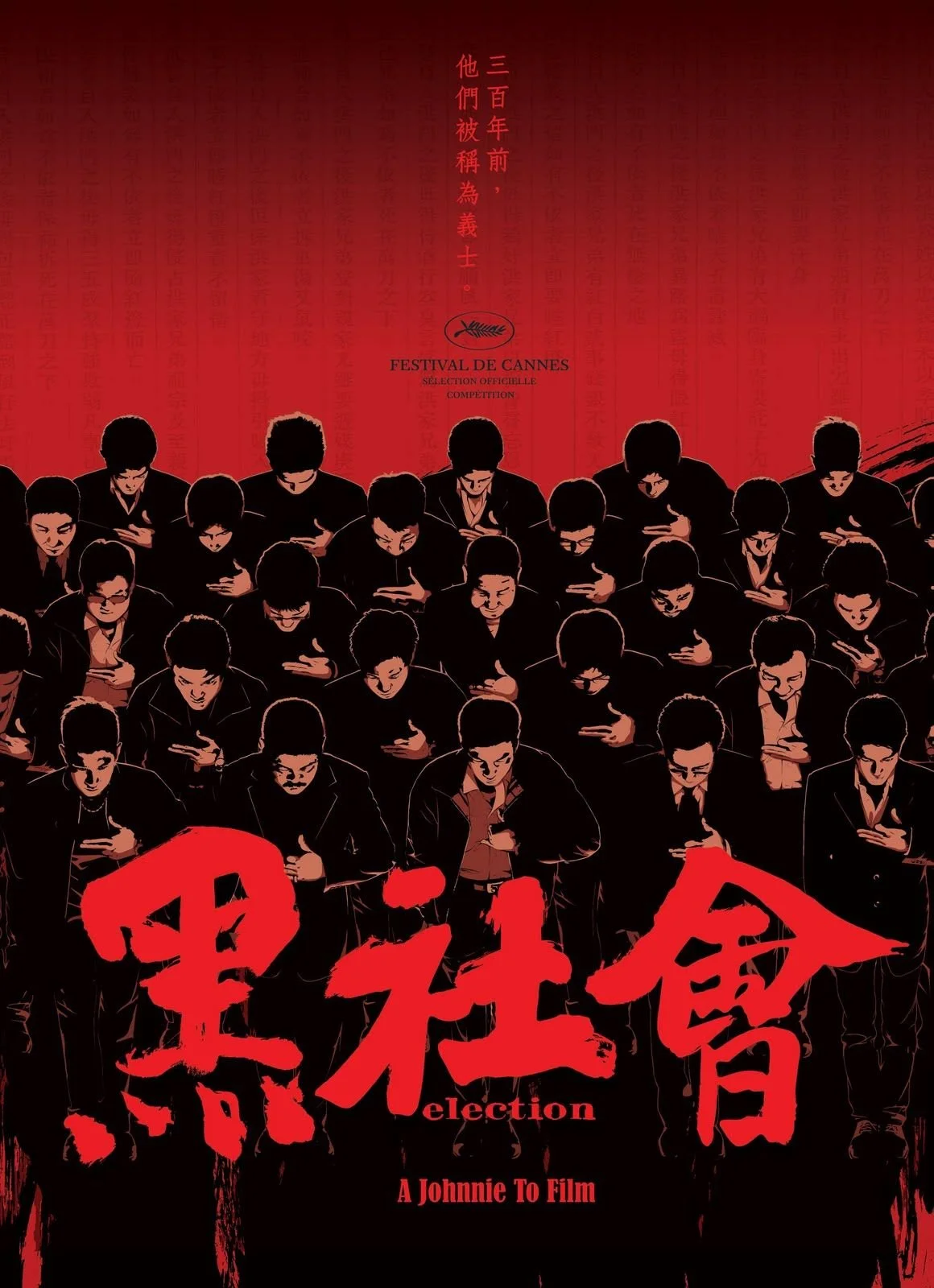
ELECTION (dir by Johnnie To, 101mns, Hong Kong, 2005)
If Hong Kong master movie makers had sibling days with western moviemakers, you might pair John Woo with Sam Peckinpah, Tsui Hark with Steven Spielberg, and Johnnie To with either David Fincher or Howard Hawks.
While Woo and To often get compared to French police & gangster auteur Jean Pierre Melville (Le Samuroi, La Cerc Rogue, Un Flic, etc), I'm not quite sure that's right. Melville's spare, laconic style of masculine codes can sometimes be almost mannered.
Woo, Hark, and To have discernible stylistic trademarks but their pictures more comfortably traffic in popcorn and crowd-pleasing. These are movies MEANT to be enjoyed even more than analyzed.
Still, there's a crisp sly undercurrent of question asking beneath the celebration of professionalism in To's crime movies that may make him the fox amongst his peers.
ELECTION, along with its sequel ELECTION 2, is celebrated as one of the great post 1997 Hong Kong handover gangster movies of the last 25 years.
Competing Triad brothers, the business minded Lok (Simon Lam) and the hot headed Big D (Tony Leung Ka-fai) position themselves to be elected the next chairman of their crime family. But when the nod goes to Lok, Big D considers all out war; brothers and codes of honor be damned.
Like one of To's other crime masterpieces, 2012's DRUG WAR, there is a masterful anthropological observational angle to systems of crime, violence, law enforcement at the same time To ALWAYS has a firm handle on propelling the story forward.
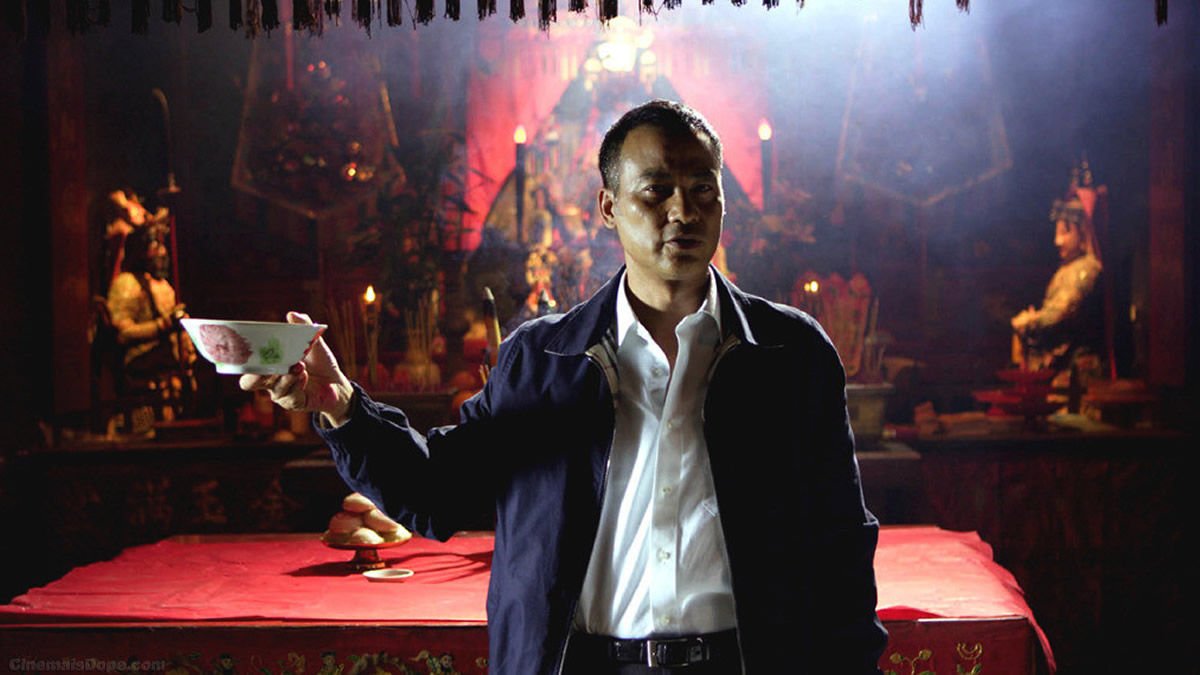
To an outsider, Election feels very Chinese. In that it values intelligence and craftiness over brute violence and power.
We understand from the beginning that Big D is breaking norms when he turns his rage on his brothers. The Chinese gangster Triads are looking glass variations of the family and ancestor centered structures of Chinese culture itself.
This forms the key tension of this movie. Lok tries to find diplomatic but effective ways to consolidate control yet prevent an all-out brother against brother crime family war. Big D grows more uncontrollable and willing to do anything the more he's told to let it go and support Lok.
The request to submit individual ambition to the collective good (even if it's in a crime family) rankles Big D.
Filmmaker To is a marvel at staging sequences of violence that feel true to how actual violence must go down.
Unlike the slo-mo bullet ballets of John Woo or the acrobatic gravity defying action of Tsui Hark, Johnnie To's fights are telephone booth knife matches. Characters bludgeon each other with rocks or big sticks. They bury machetes deep into shoulder blades.
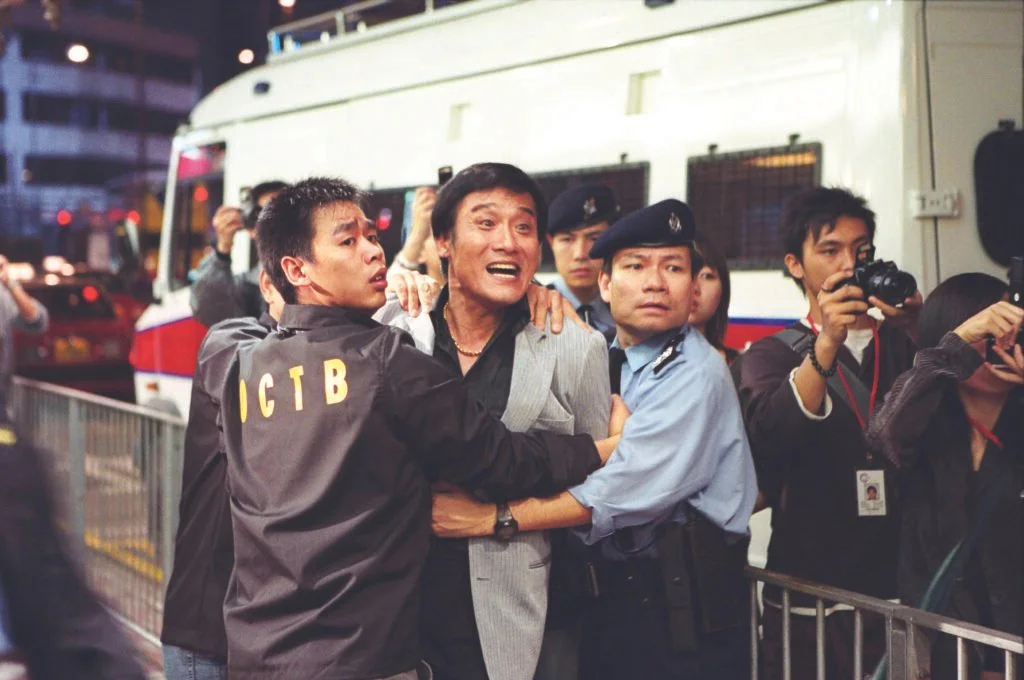
Johnnie To is dealing with distilled archetypes. If Lok is calculated cool, Big D is all emotional hot headedness and flash.
There's also an economy of action and violence in To movies. When the violence happens, it's almost shocking. But To keeps you riveted with the machinations of the gangsters, the police, the foot soldiers as the situation threatens to get out of control for all of them.
To came to prominence in the post 1997 handover of Hong Kong back to mainland China (though he had been directing since 1980) and like many of his lead characters, there's a cagey reserve to how To tells stories. But this is also To's great strength. He's the crafty Odysseus among the Greek generals at the gates of Troy. His stories, movies, approach are as deliberated as they are visceral.
You're constantly thrown off with the twists and turns of ELECTION. Your expectations are delightfully frustrated.
But the final sequence (no spoilers, never worry) is genuinely shocking. And there's something about it that makes you think about it long after the cut to black and credits.
What kind of world do we live in? What moves do we have to make to avoid being out maneuvered by all the vipers around us?
ELECTION exists in a cinematic world where people pretend that reason and persuasion can win out the day. But To hints at something much darker and more unsettling.
You understand a character's decision completely in the final scene. But you're also left to grapple with the ramifications of a world in which such decisions must be made to settle conflicts.
It doesn't have to be your world. Or my world. But it is still an undeniable part of the world. And it's not going anywhere.
Craig Hammill is the founder.programmer of Secret Movie Club