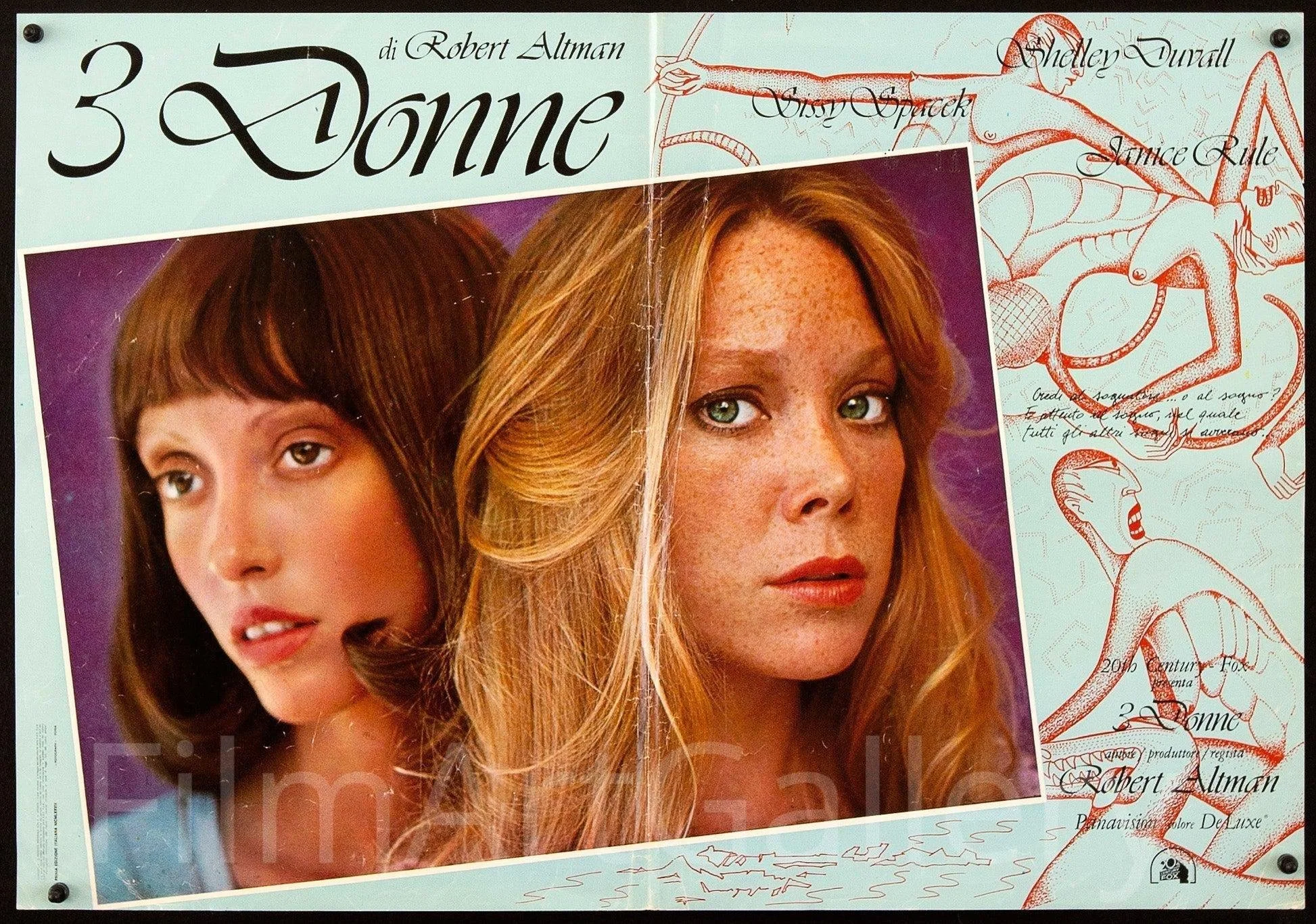
WE'VE BEEN HERE BEFORE: Robert Altman's 3 WOMEN (wri & dir by Robert Altman, w/ Shelley Duvall, Sissy Spacek, Lion's Gate, 123mns, 1977, USA)
Ingmar Bergman's PERSONA, Robert Altman's 3 WOMEN, and David Lynch's MULHOLLAND DRIVE may be three of the finest examples of the "female driven psychological character study" subgenre.
Bergman's PERSONA appears to have strongly shaped the other two films. Lynch's MULHOLLAND DRIVE demonstrates indebtedness to both predecessors.
Altman, the 1970s iconoclastic director known for NASHVILLE, THE LONG GOODBYE, and MCCABE & MRS. MILLER, who experienced a 1990s renaissance with THE PLAYER and SHORT CUTS, previously explored this territory.
His 1972 film IMAGES combines elements of REPULSION and PERSONA but fails to fully succeed despite moments of cleverness.
3 WOMEN similarly struggles initially—for approximately 80 minutes the viewer's patience may be tested. Then something shifts, and suddenly the film becomes remarkable.
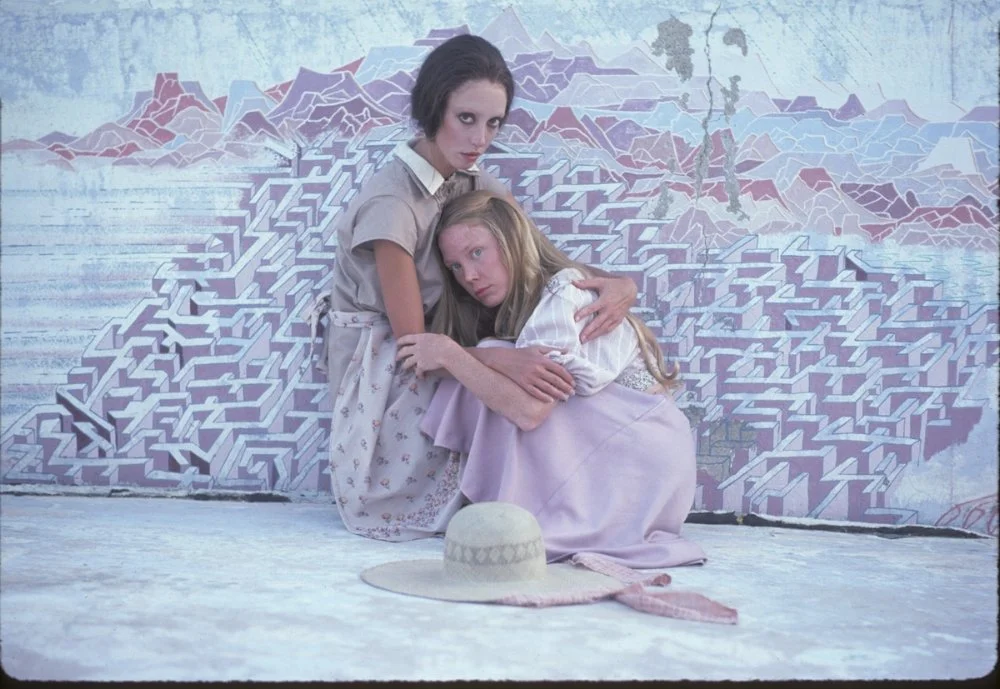
The narrative centers on Pinky (Spacek), a young admirer who idolizes coworker Millie (Duvall) while training at a California desert spa. The pair becomes roommates. Millie frequents a bar called Dodge City where its taciturn owner Willie paints disturbing murals featuring anthropomorphic creatures.
As Altman, the screenwriter, effectively establishes intrigue from the opening: why do these protagonists share the same given name and hail from identical Texas origins? This mystery sustains engagement through the extended setup.
Duvall and Spacek intentionally portray somewhat irritating characters—people around them demonstrate indifference, avoidance, or ridicule. Altman employs his signature compositional choice of repetitive musical accompaniment that transforms into thematic material. The flute-driven chamber music becomes progressively grating while simultaneously serving the narrative.
The approximately final 30 minutes shift into psychedelic territory. Identity boundaries dissolve and invert. The concluding scene—withheld here to preserve surprise—provides explanatory context.

Unlike Altman's other acclaimed works, this film carries a pervasive melancholic quality. His characteristic humor, spontaneity, and vitality largely absent. However, this restraint yields one of his most cinematically accomplished and impactful achievements.
Visual motifs and the restless, zooming camera employed subtly in his comedies and humanist pieces operate here with near-frenzied intensity, eventually approaching experimental filmmaking.
The revelation functions more like THE TWILIGHT ZONE than Lynch's approach. Despite its incongruity, the cast and crew's commitment to this hallucinatory vision earns sufficient credibility through powerful performances that the film's central message resonates.
Like PERSONA and MULHOLLAND DRIVE, this work invites extended contemplation beyond viewing. Notably, one male character proves crucial to comprehending the women's trauma—suggesting deeper Bergman and Lynch connections emerge upon reflection.
The film rewards patience; it develops gradually rather than explosively.
Craig Hammill established and programs Secret Movie Club